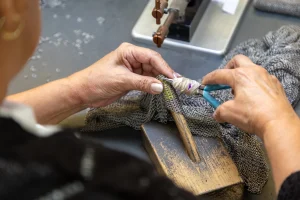
Chainmail or metal mesh PPE — gloves, aprons, and sleeves made from interlocking stainless steel rings — should be washed after every shift with warm water and a mild, food-safe detergent, dried completely, inspected for damaged rings, and stored flat or hung in a ventilated area. Done consistently, that routine keeps your cut-resistant PPE in service longer and keeps your plant compliant.
What is chainmail mesh PPE?
Chainmail mesh PPE is a specialized form of cut-resistant PPE that offers exceptional protection in hazardous work environments. Made up of interlocking metal rings, chainmail provides a physical barrier against potential hazards such as cuts, punctures, and abrasions.
The durability and flexibility of chainmail mesh personal protective equipment make it a top choice for butchers, meat and seafood processing, metalworking, welding, and construction. Chainmail aprons, sleeves, and gloves are the perfect combo of protection.
PPE wearing out faster than it should?
International Services repairs chainmail mesh PPE — gloves, aprons, sleeves, and more — and returns it in like-new condition in as little as four weeks, at a fraction of the cost of new.
Why maintenance matters more than most plants realize
Chainmail mesh PPE is built to take punishment. The interlocking ring structure deflects blades, absorbs impact, and holds up through shift after shift of high-intensity knife work. But that same structure — thousands of small rings with gaps between them — creates hiding spots for moisture, food debris, and cleaning chemicals.
Left unchecked, those residues break down the metal over time. Rings corrode. Closures weaken. Sections of mesh start to gap. A glove that looked fine on Friday can be a compliance issue by Monday morning.
Consistent cleaning and inspection is the difference between PPE that lasts and PPE that quietly fails. It’s also cheaper than the alternative: a new chainmail glove runs around $120. A repaired one costs about $20.
How to clean chainmail mesh PPE: step by step
Chainmail mesh PPE is best cleaned by hand using warm water and a food-safe, mild detergent — the same approach recommended for most stainless steel equipment in meat and poultry processing environments.
What you’ll need:
- Warm water
- Mild, food-safe detergent (no bleach, no harsh chemicals)
- Soft-bristle brush
- Clean dry towel or forced-air drying station
Step 1. Rinse first.
Run warm water over the full surface of the PPE. This loosens debris before you apply detergent and prevents buildup from getting ground deeper into the rings.
Step 2. Scrub the rings and joints.
Apply detergent and work a soft brush across the mesh in multiple directions. The goal is to reach the interior surfaces of the rings and the joint points — that’s where debris and organic residue accumulate. Don’t skip the strap attachments and closures.
Step 3. Rinse thoroughly.
Residual detergent left in the rings traps moisture and can accelerate corrosion. Rinse until the water runs clear.
Step 4. Dry completely before storing.
This is the step most facilities skip, and it’s the most important one. Stainless steel is corrosion-resistant — not corrosion-proof. Moisture trapped in the rings, especially in a folded or stored position, degrades the metal over time. Towel-dry first, then allow full air-dry before storing. If your facility uses forced-air drying stations, even better.
What to avoid:
- Bleach and chlorine-based cleaners — they corrode stainless steel rings faster than ordinary wear does
- Storing PPE wet or folded in a closed container
- Dishwashers or industrial washing machines — high heat and harsh detergents stress the ring structure and accelerate corrosion
- Leaving PPE in standing water between shifts
How to inspect chainmail mesh PPE
Cleaning is also your best inspection window. When the mesh is wet and flat, problems are easier to see. Build inspection into your cleaning routine — it adds two minutes and catches issues before they become safety problems.
Check for these during every inspection:
- Broken or missing rings — run your fingers across the mesh in sections. Any gap or irregularity needs a closer look.
- Deformed rings — rings that are bent, flattened, or no longer circular reduce the mesh’s cut resistance. The interlocking structure only works when each ring holds its shape.
- Corrosion — surface discoloration, rust spotting, or pitting on the rings. Early-stage corrosion is manageable; widespread corrosion compromises structural integrity.
- Weak closures and worn straps — closures and straps take significant stress during use. Check that they’re secure and show no fraying or cracking.
- Uneven mesh lay — if the mesh no longer lies flat and uniform when held up, the ring pattern has likely been disrupted somewhere.
Inspect before each shift, not just after washing. Damage can develop mid-use — a ring failure during a shift is a safety event, not just a maintenance issue.
Storage: the part of chainmail PPE maintenance that gets ignored
Clean PPE stored wrong still degrades. Here’s what proper storage looks like in a processing environment:
- Store flat or hanging — folding and stacking puts pressure on ring joints and can cause deformation over time.
- Ventilated area only — closed bins and lockers trap humidity. A mesh hook or open rack keeps air moving around the metal mesh PPE between uses.
- Separate from harsh chemicals — don’t store chainmail in close proximity to cleaning solvents, bleach products, or acidic sanitizers. Fumes alone can accelerate surface corrosion.
- Dry before storage, every time — even if the PPE “feels” dry, ring interiors can hold moisture. Build in enough dry time before the next storage cycle.
A simple rotation log — tracking which PPE went out, when it was cleaned, and when it was last inspected — also helps plants maintain a predictable spare pool and avoid the scramble when a piece comes out of service.
When cleaning isn’t enough: repair vs. replace
Not everything that looks worn out is worn out. That’s one of the more common misses in meat processing plant PPE programs.
A glove with a broken ring or a failed strap closure isn’t necessarily garbage — it’s a repair candidate. Chainmail mesh PPE that’s professionally cleaned, structurally repaired with OEM parts, and quality-checked can return to service performing at spec. The cost difference is significant: a repaired glove typically runs about $20 versus $120 for a new one.
Signs a piece of PPE needs professional repair, not just cleaning:
- One or more broken or missing rings
- Strap or closure failure
- Corrosion concentrated in a specific section (not surface-wide)
- Mesh that won’t lie flat after cleaning
Signs it’s time to replace a piece of metal mesh PPE entirely:
- Widespread corrosion across multiple ring sections
- Structural deformation that can’t be restored
- Repeated ring failures in the same area after repair
If you’re unsure, send it in. At International Services, every piece gets inspected before any repair work starts. If it can’t be brought back to original safety spec, we’ll tell you — and we won’t charge you for the assessment.
Running a rotation program?
We work with meat and poultry processing facilities of all sizes — from independent operators to multi-plant operations running through Bunzl and Hantover. Send us your damaged mesh PPE and we’ll return it in like-new condition in as little as four weeks.
What a professional cleaning and repair service actually does
When your chainmail mesh PPE comes to International Services, here’s what happens:
- Receive and log — every piece is tracked from the moment it arrives.
- Inspect and assess — we check every ring, seam, and closure and document what needs repair.
- Disassemble — straps, buckles, and snaps are removed so nothing gets missed.
- Clean — the mesh is cleaned to remove all debris, food residue, and contaminants before any repair begins.
- Repair to spec — damaged sections are rebuilt using OEM Niroflex rings and parts. No substitutions.
- Quality check — every piece goes through a final inspection before it leaves. If it doesn’t meet the standard, it doesn’t go back to your operation.
- Sanitize and return — your mesh PPE comes back clean, repaired, and ready for the floor.
International Services is the only Authorized Niroflex Repair Center in the U.S. That means repairs are done using the same parts and welding methodology the manufacturer specifies — not close approximations, not off-brand substitutes.
Frequently asked questions
Wash chainmail mesh PPE with warm water and a mild, food-safe detergent. Scrub the rings and joints with a soft brush to clear debris and buildup, then rinse thoroughly. Dry completely before storing — trapped moisture is the fastest route to corrosion. Never use bleach or harsh chemicals, and avoid leaving wet mesh folded in a container.
Replace chainmail gloves when rings are broken, missing, or visibly deformed — or when the mesh no longer lies flat and uniform across the hand. Corrosion that has compromised multiple rings is also a replacement signal. Many gloves that look worn out are actually repairable for a fraction of the cost of new metal mesh PPE.
High-quality stainless steel chainmail is corrosion-resistant, but it is not rust-proof. Moisture, food acids, and cleaning chemicals can degrade the metal over time — especially if the mesh is stored wet or folded tightly without drying. The fix is simple: rinse after every shift, dry completely, and store flat or hung in a ventilated area. Regular inspection catches early corrosion before it spreads.
Hand washing with warm water and mild detergent is the safest method. Dishwashers expose chainmail to high heat and harsh detergents that accelerate corrosion. Washing machines can stress and distort the ring structure. If your mesh is showing wear, a professional repair and cleaning service will restore it and inspect it at the same time.
About International Services
International Services, LLC (ISL) has specialized in chainmail mesh PPE repair since 1981. We are the only Authorized Niroflex Repair Center in the United States, specializing in the repair and restoration of chainmail mesh PPE for meat, poultry, and food processing facilities. Based in Omaha, Nebraska, ISL repairs gloves, aprons, sleeves, and tunics using OEM parts and manufacturer-specified welding methodology — returning equipment to like-new condition in as little as four weeks, at roughly 10% of the cost of new PPE. For facilities managing PPE at scale, that math adds up fast. If your chainmail mesh is wearing out faster than your budget can keep up, contact us for support starting a mesh PPE rotation program.